
- August 6, 2026
- Universal White Cement
- Pool Finishes
- No Comments
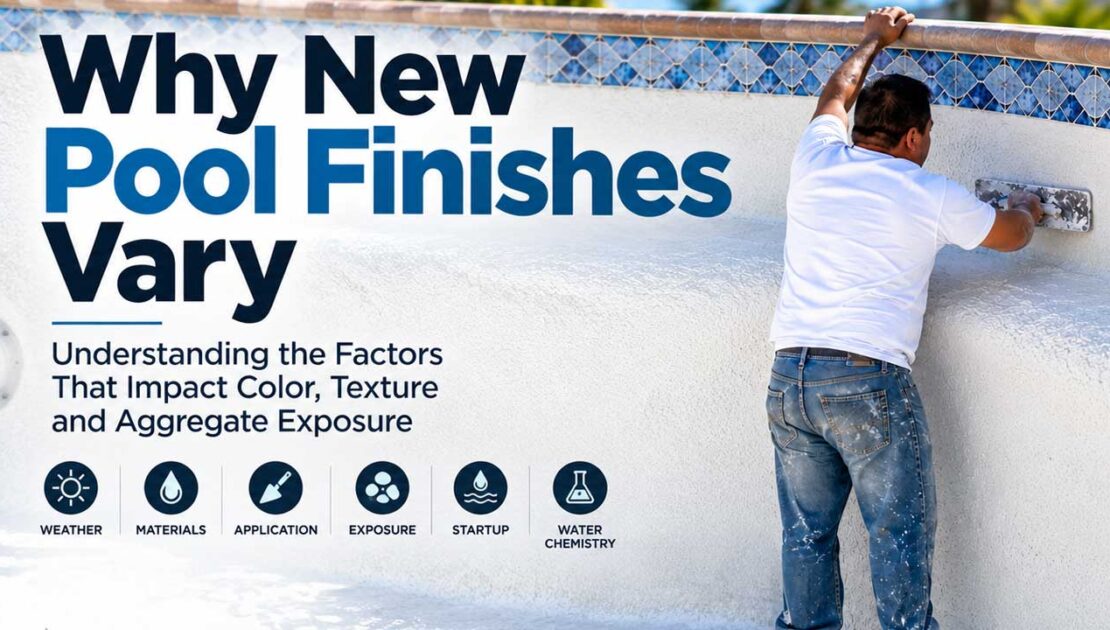
Why New Pool Finishes Vary: Understanding Color, Texture and Aggregate Exposure
Why do new pool finishes vary? The answer has a lot to do with how cementitious pool finishes are made and installed.
Unlike a manufactured surface produced under controlled factory conditions, a pool finish is mixed, pumped, placed, hand-troweled, exposed and cured in the field. Throughout that process, temperature, humidity, sunlight, wind, substrate conditions, mixing, application technique, exposure, startup and water chemistry can all influence the final appearance.
That means two areas of the same pool—or even two pools using the same finish—may not look exactly alike.
Some degree of variation is a natural characteristic of cementitious pool finishes. The National Plasterers Council (NPC) recognizes that these materials can exhibit inherent shading and color variation and that exposed aggregate finishes can show differences in aggregate concentration across the finished surface.
The objective, therefore, isn’t necessarily to eliminate every possible variation. That’s unrealistic with a hand-applied cementitious product.
The objective is to understand the variables involved and control as many of them as possible.
Table of Contents
- Why Cementitious Pool Finishes Naturally Vary
- How Weather Impacts a New Pool Finish
- How Substrate Conditions Affect Pool Finishes
- Mixing and Application Variables
- Why Hand Application Matters
- What Causes Pool Finish Color Variation?
- Why Aggregate Exposure Matters
- How Exposure Control Can Help
- Startup and Water Chemistry
- Controlling the Variables
Why Cementitious Pool Finishes Naturally Vary
At Universal White Cement, we manufacture cementitious materials used as the foundation of swimming pool finishes. That gives us an important perspective on finish variation: consistency starts with the material, but it doesn’t end there.
Once cement is mixed with water, hydration begins. This chemical reaction is what allows the material to develop its strength and become the hardened surface of the pool.
From that moment forward, however, the material is also interacting with its surroundings.
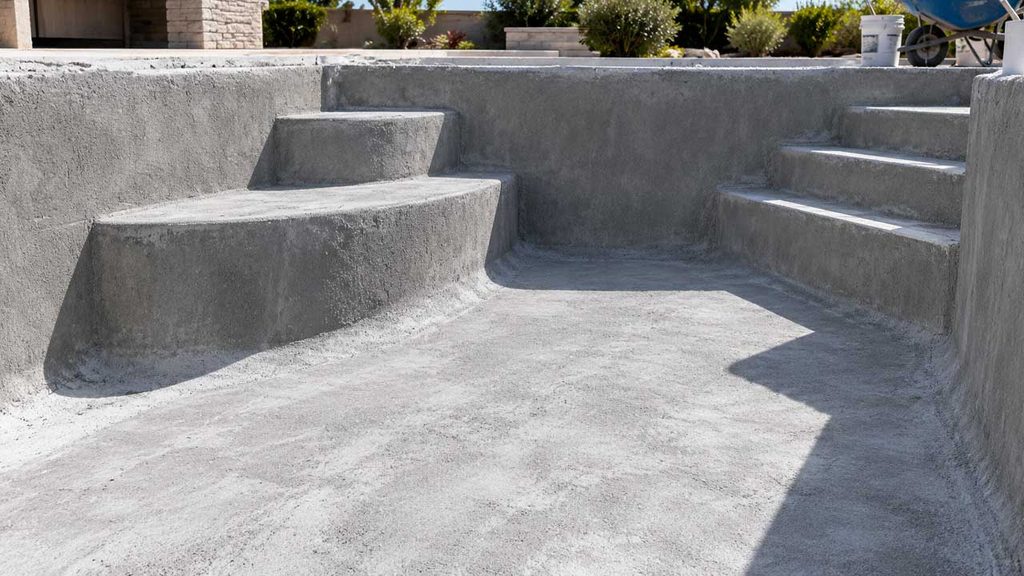
Unlike concrete poured into a uniform form, a swimming pool presents a complicated working environment. Crews are applying a relatively thin cementitious coating over walls, floors, steps, benches, coves, transitions and other features while environmental conditions continue changing around them.
Even within a single swimming pool, those conditions may not be uniform.
How Weather Impacts a New Pool Finish
Walk around a pool during installation and you’ll quickly see one of the challenges.
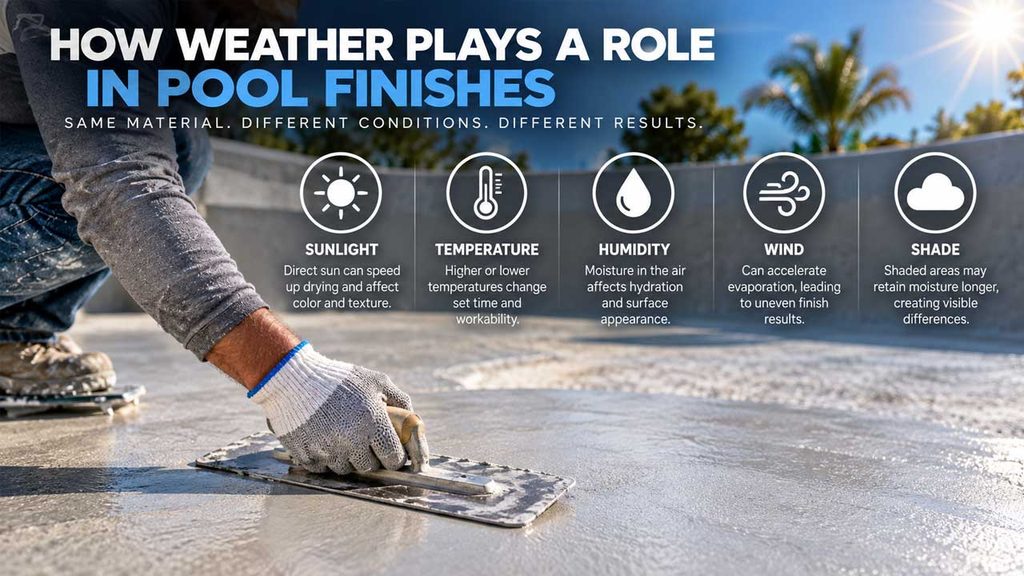
One wall may be receiving direct sunlight while another is shaded. The floor may be warmer than a wall. A raised spa or sun shelf may experience different conditions from the deep end.
Those temperature differences can affect how quickly the material sets and loses moisture.
Humidity and wind introduce additional variables. A warm, dry breeze can accelerate evaporation, while a protected area of the pool may retain moisture longer.
This means the material on one side of a swimming pool can behave differently from material installed somewhere else in the same vessel.
Experienced plaster crews constantly adjust to these changing conditions, but they cannot make the sun, wind, temperature and humidity identical across every square foot of the pool.
How Substrate Conditions Affect Pool Finishes
What’s underneath the new finish matters too.
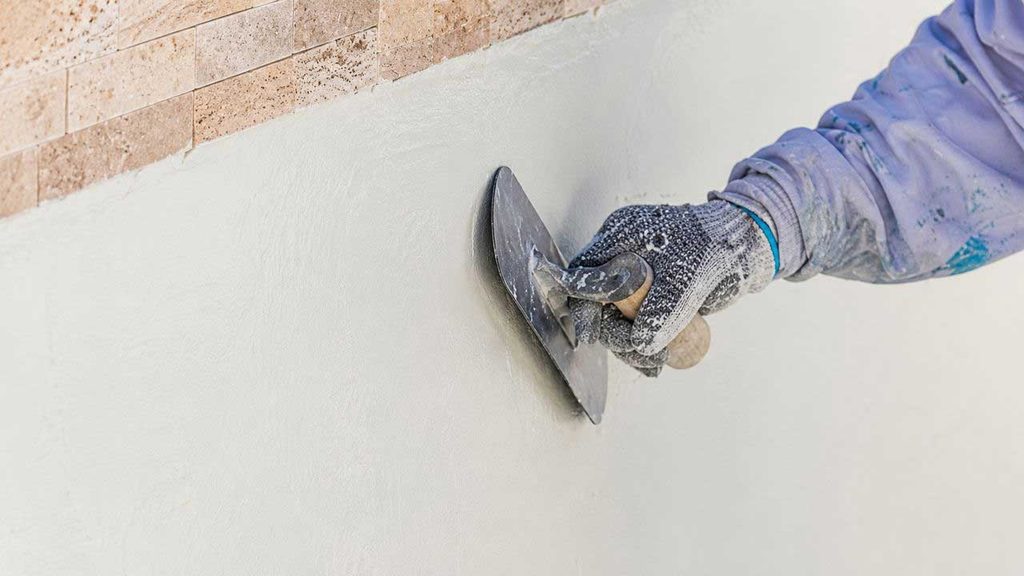
A cementitious pool finish is applied over a prepared substrate, and conditions across that substrate may vary. Temperature and moisture absorption can influence how the newly applied material behaves.
If one portion of the substrate pulls moisture differently from another, the finish above it may experience different moisture conditions during a critical period of application and hydration.
This is one reason proper surface preparation and application procedures are so important.
Mixing and Application Introduce More Variables
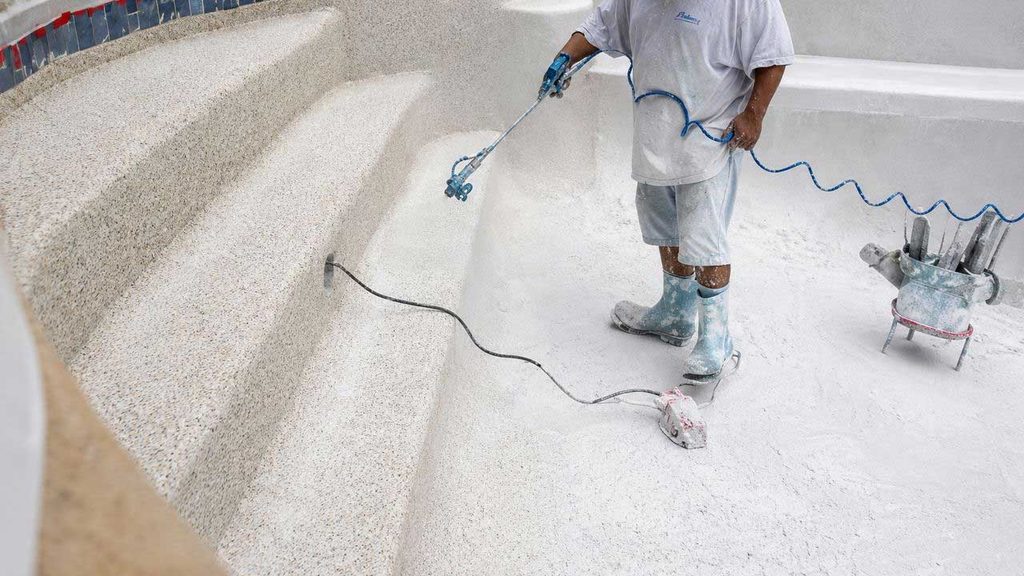
Most swimming pools require far more material than can be prepared in a single batch.
Throughout the installation, material is repeatedly mixed, transported, pumped and placed. Maintaining the correct proportions and procedures from beginning to end is critical to consistency.
Water is particularly important.
Cement needs water to hydrate, but changing the amount of water in a cementitious mixture can change how that material behaves. Mixing procedures, timing and formulation therefore need to remain as consistent as possible throughout the job.
The same principle applies to pigments and aggregates. Careful batching helps maintain the intended color and aggregate distribution throughout the installation.
The goal is repeatability: each batch should behave as much like the previous batch as possible.
Why Hand Application Matters
There’s another variable that can’t be overlooked: craftsmanship.
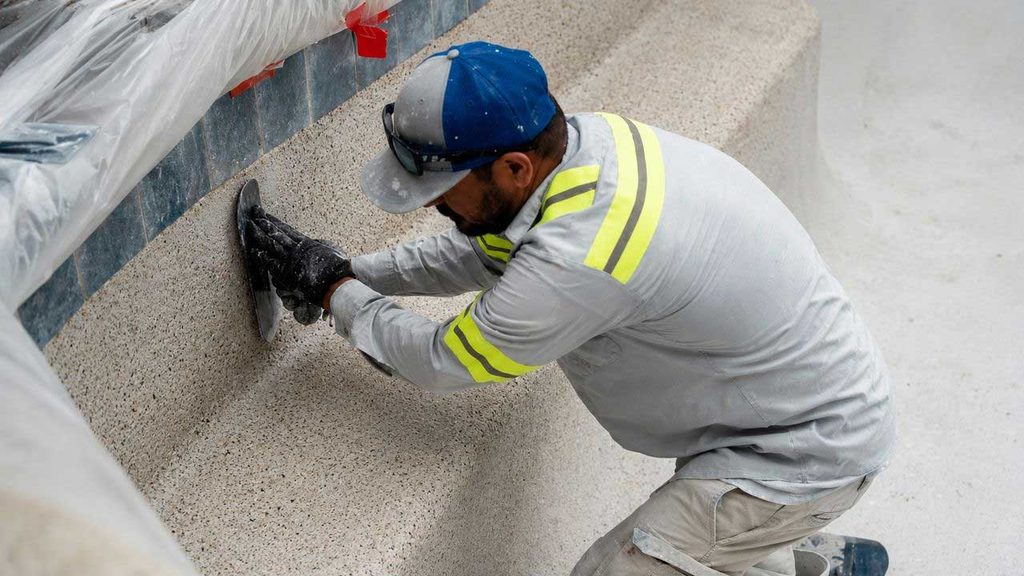
Pool finishes aren’t simply poured into a mold and left alone. Skilled applicators work the surface by hand.
Troweling consolidates, smooths and finishes the material as it is being installed. Timing and technique matter, and the physical geometry of a swimming pool means every area can’t necessarily be worked in exactly the same way.
A vertical wall is different from a floor. Steps and benches are different from broad open sections. Corners, coves, fittings and transitions all require attention from the applicator.
This is part of what makes pool plastering a skilled trade.
It is also why some variation is inherent in a handcrafted finish. The National Plasterers Council recognizes minor variations in texture, thickness, levelness and coloration as characteristics associated with hand-applied cementitious pool finishes.
What Causes Pool Finish Color Variation?
Color variation is one of the first things homeowners tend to notice in a new pool.
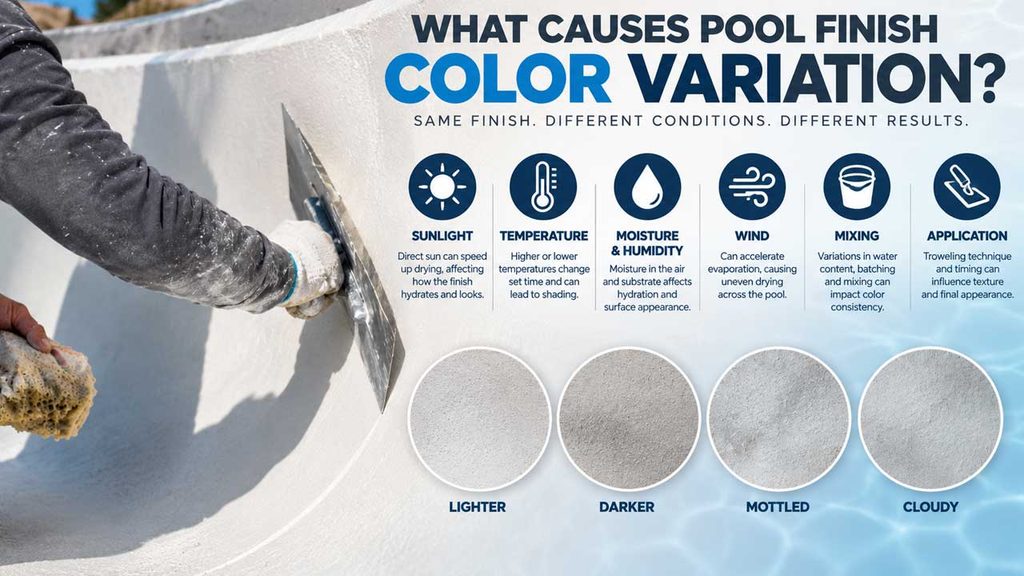
Cementitious finishes can exhibit subtle shading, cloudiness or mottling as the material hydrates and cures. Differences in moisture content and hydration rates within the cement matrix can contribute to these variations.
Colored finishes can make those differences more noticeable.
But it’s also important to distinguish normal variation from other changes in appearance.
What a pool looks like immediately after installation isn’t necessarily what it will look like after filling and startup. Cement continues hydrating after application, and the interaction between the new surface and pool water becomes increasingly important.
That is why evaluating a pool finish involves more than simply looking at the dry surface immediately after installation.
Why Aggregate Exposure Matters
Pebble and quartz finishes introduce an additional step that has an enormous influence on their final appearance: exposure.
These finishes contain decorative aggregate held within the cement matrix. To produce the desired finished texture and appearance, cement paste at the surface must be removed to reveal that aggregate.
How much is removed matters.
If too little paste is removed, more cement remains visible and the aggregate may appear less pronounced. If more paste is removed, the aggregate becomes more prominent and the texture can change.
If the depth of exposure varies across the pool, the apparent color, aggregate concentration and texture can vary with it.
This is important because the material may already be responding to different conditions by the time exposure begins.
One section may have been placed earlier. Another may be warmer. One wall may have been in direct sun while another remained shaded.
The applicator must account for those conditions while attempting to produce a consistent aggregate reveal across the entire swimming pool.
Traditionally, pebble exposure has relied heavily on washing techniques and the applicator’s judgment to determine when and how aggressively different sections should be exposed.
That skill remains incredibly important.
But from a process-control standpoint, exposure represents another variable that can influence the final result.
How Exposure Control Can Help Create a More Consistent Pool Finish
At Universal White Cement, we look at pool finishing through the lens of process control.
There are variables an applicator can’t eliminate. You can’t turn off the sun. You can’t completely eliminate wind. You can’t make every wall, step and floor remain at precisely the same temperature throughout an installation.
So the better question is:
Which variables can we control better?
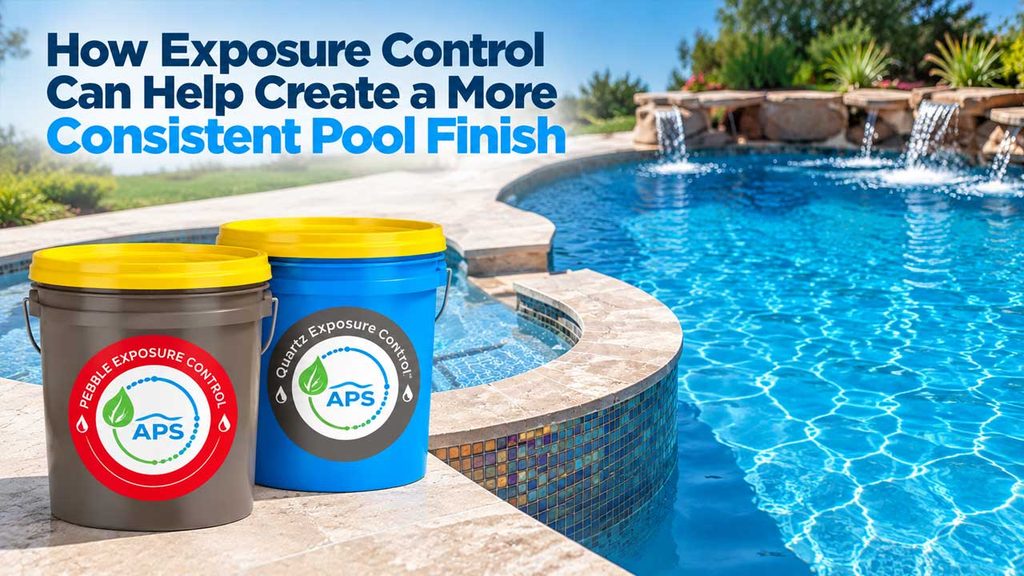
That thinking is behind Universal White Cement’s Advanced Exposure Control systems.
Advanced Exposure Control uses water-based liquid chemistry engineered to provide a more controlled and even reveal of the desired aggregate texture.
Rather than relying solely on traditional wand exposure, Exposure Control gives applicators another method for managing the exposure process and the amount of cement paste removed from the surface.
The goal is greater repeatability.
A more controlled aggregate reveal can help reduce differences caused by inconsistent exposure and give the applicator greater control over the finished texture and appearance.
Universal offers separate Advanced Exposure Control formulations for pebble and quartz finishes because different finish systems require different approaches.
The system can also eliminate the need for traditional wand exposure, allow same-day exposure of pebble and quartz finishes, operate under both hot and cold conditions, and significantly reduce the slurry and wasted cement associated with the exposure process.
Importantly, Exposure Control doesn’t eliminate every potential cause of pool finish variation.
It isn’t intended to.
Temperature still matters. Mixing still matters. Application still matters. Troweling still matters. The substrate still matters. Startup and long-term water chemistry still matter.
Exposure Control addresses a specific part of that larger process: the consistency of aggregate exposure.
And when you’re working with a material influenced by so many different conditions, removing or reducing even one significant variable can make a meaningful difference.
How Startup and Water Chemistry Affect a New Pool Finish
The installation isn’t the end of the story.
Once a newly finished swimming pool is filled, cement hydration continues and the new surface begins interacting with the fill water.
Proper startup procedures are important during this period.
The National Plasterers Council identifies startup and ongoing water chemistry as important factors in the appearance and longevity of cementitious pool finishes. Calcium compounds associated with cement hydration can migrate toward the surface during the early life of a finish, while improperly balanced water can contribute to scaling, staining, etching or deterioration.
Those conditions can change how the finish appears even when the original installation was performed properly.
This is why a successful pool finish should be viewed as a complete system.
Quality materials matter. Proper mixing matters. Good application matters. Consistent exposure matters. Proper startup matters.
And maintaining appropriate water chemistry matters long after the installation crew has left.
Better Pool Finishes Start With Controlling the Variables
There is no single explanation for why new pool finishes vary.
A cementitious pool interior is the result of materials, chemistry, environmental conditions and craftsmanship all interacting during a relatively short installation window, followed by weeks and months of continued hydration and exposure to pool water.
Some variation is inherent in that process.
But inherent variation shouldn’t stop the industry from looking for ways to make the process more consistent.
That’s where better materials, better procedures and better process control can make a difference.
At Universal White Cement, our approach is to identify the variables professionals can control and develop products that give them greater control over the finished result.
Advanced Exposure Control is one part of that approach.
It doesn’t change the weather. It doesn’t replace proper mixing, skilled troweling or responsible startup. And it doesn’t remove the craftsmanship from pool finishing.
It gives the craftsman greater control over one of the most important steps in creating a beautiful exposed aggregate finish.
Because while every variable in pool finishing can’t be eliminated, every variable we can better control is one less variable left to chance.