
- September 17, 2026
- Universal White Cement
- Pool Plaster
- No Comments
New Pool Plaster Startup: Why the First 28 Days Matters
Universal White Cement examines how initial filling, water chemistry, and startup practices influence the appearance and long-term performance of cementitious swimming pool finishes.
A professional plastering crew can spend years refining its application techniques, perfecting trowel work, and selecting materials that deliver a consistent finish. Yet some of the most consequential decisions affecting that finished surface occur after the crew has completed its work.
The first fill introduces a newly applied cementitious finish to an environment that will influence its appearance and durability for years to come. Water chemistry, circulation, brushing, and chemical additions all become important factors during this initial period.
At Universal White Cement, we understand that producing a quality swimming pool interior involves more than cement formulation and application. Proper startup practices are an essential continuation of the installation process.
The National Plasterers Council (NPC) Recommended Pool Start-Up Procedures provide an established framework for protecting new plaster finishes. The guidance identifies the first 28 days as a particularly sensitive period, when cementitious surfaces are more susceptible to staining, scaling, and discoloration.
For professional plasterers, understanding what happens during those first four weeks is important not only for protecting the finished product, but also for ensuring that the responsibility for maintaining it is clearly communicated.
Why the First Fill Deserves Special Attention
When a cementitious pool finish is initially submerged, hydration continues within the material. Portland cement reacts with water to develop the compounds responsible for binding the aggregate and establishing the hardened surface.
Although the finish has developed sufficient rigidity to permit filling, its cementitious matrix continues to mature. At the same time, the new surface begins interacting with the minerals and chemicals present in the fill water.
This makes the initial water source an important consideration.
Water that is unusually high or low in calcium hardness, pH, or alkalinity may require adjustments to standard startup procedures. Dissolved metals can introduce additional staining concerns.
The NPC recommends testing the fill water for pH, total alkalinity, calcium hardness, and metals before beginning the startup process. Recording those results establishes a baseline for subsequent chemical adjustments.
The physical filling procedure also matters.
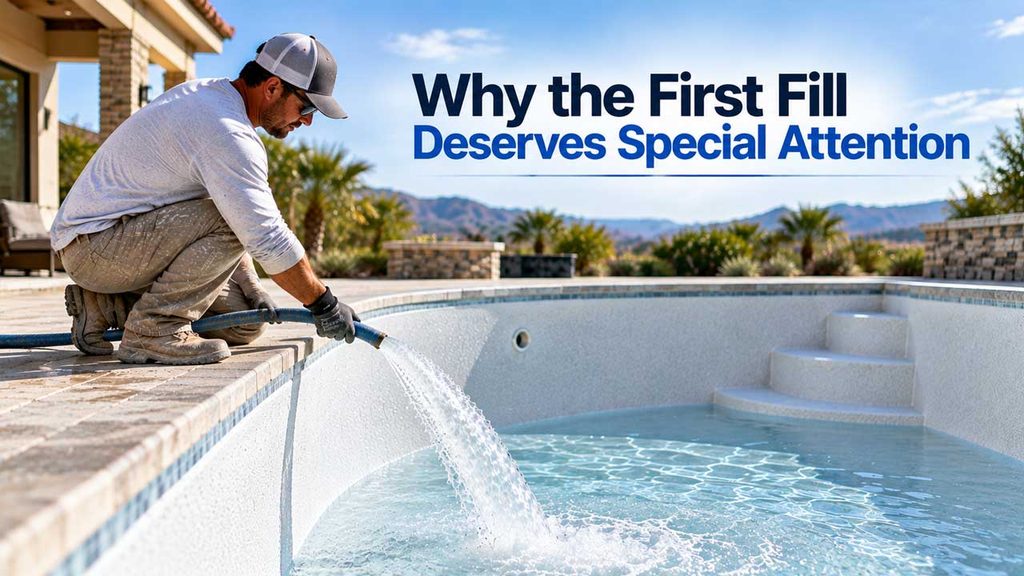
According to the NPC, pools should be filled continuously with clean potable water to the intended operating level. Interrupting the fill can contribute to a visible waterline or bowl ring, while allowing water from external sources to enter the pool may produce streaking.
The organization also recommends protecting the surface from direct hose contact and ensuring filtration equipment is operational before the pool is filled.
For plastering contractors, these precautions demonstrate why the first fill should be coordinated as carefully as the final finishing operations. A properly applied interior deserves an equally controlled transition into service.
Understanding the Role of Water Balance
Once the pool is filled, managing water chemistry becomes the central priority.
Fresh cementitious finishes are particularly sensitive to water that is excessively aggressive or prone to depositing calcium carbonate. Either condition can affect the appearance and integrity of the surface.
The NPC’s startup procedures establish a sequence for adjusting total alkalinity, pH, and calcium hardness rather than attempting to bring every parameter to its final operating range immediately.
On the first day, the recommended procedure targets total alkalinity of approximately 80–100 ppm and pH between 7.2 and 7.6. Calcium hardness is initially adjusted to 80–100 ppm when necessary, then increased gradually during the following days.
By Day 4, the NPC recommends raising calcium hardness to a minimum of 200 ppm.
This progressive approach provides a controlled method for establishing water balance during the earliest stages of startup.
The distinction between individual chemistry readings and overall water balance is important. A pool may have a pH within the recommended range while still exhibiting a tendency toward calcium carbonate dissolution or precipitation.
That is where the Langelier Saturation Index (LSI) becomes particularly valuable.
The LSI evaluates calcium carbonate saturation using pH, carbonate alkalinity, calcium hardness, temperature, and total dissolved solids.
Water with a negative LSI tends toward calcium carbonate dissolution, creating conditions associated with etching and deterioration of cementitious surfaces. Water with a strongly positive LSI tends toward calcium carbonate precipitation, increasing the potential for scale formation.
The NPC recommends maintaining an LSI between 0.0 and +0.3 during ongoing maintenance, with particular attention to the first six months after startup.
For plastering professionals, this reinforces an important point: maintaining an appropriate pH alone does not guarantee that the water is properly balanced for a cementitious finish.
Why Brushing and Circulation Matter
One of the most visible characteristics of a newly plastered pool is the appearance of plaster dust during the initial startup period.
Fine particles can enter the water as the surface undergoes its early exposure to circulation and chemical adjustment. If allowed to accumulate, this material can contribute to cloudiness and surface deposits.
The NPC recommends thoroughly brushing the entire interior at least twice daily during the initial startup period, continuing the prescribed brushing schedule through the first week.
Circulation and filtration are equally important. The NPC calls for continuous pump and filtration operation for seven days, or until plaster dust has been removed and the water is no longer cloudy, with a minimum continuous operating period of 72 hours.
The objective is to remove suspended material before it can accumulate on the finish or interfere with water clarity.
Equipment selection also deserves attention. Wheeled vacuums and wheeled pool cleaners should not be used during the first 28 days under the NPC recommendations. Brush vacuums and non-wheeled cleaning methods are permitted.
Once plaster dust has been removed and an effective cleaning system is operating, brushing requirements can transition toward the removal of visible debris and the dispersion of added chemicals.
For applicators, these recommendations highlight the importance of communicating appropriate cleaning procedures to whoever assumes responsibility for the pool after installation.
Chemical Additions Require Proper Timing
New pool finishes should not be treated as though they are already in routine service.
The NPC recommends withholding chlorine during the first 48 hours, then introducing chlorine on Day 3 to establish a free chlorine concentration of approximately 1.5–3.0 ppm.
Cyanuric acid adjustments begin on Day 4, with a recommended range of 30–50 ppm. The NPC cautions that concentrated cyanuric acid can discolor pigmented finishes, making proper distribution and brushing important.
Saltwater pools require additional consideration. The NPC recommends that salt not be added during the first 30 days following startup.
Heater operation should also be delayed until water chemistry is balanced and plaster dust has been removed, in accordance with equipment and finish manufacturer recommendations.
These restrictions are intended to protect the new surface while establishing suitable operating conditions.
Chemical handling practices remain critical throughout the process. Concentrated chemicals should not be allowed to contact the finish directly, and additions must follow appropriate dilution, circulation, and safety procedures.
The full NPC startup card provides the recommended sequence and should be consulted rather than relying on isolated chemistry targets.
The Handoff Between Plasterer and Pool Service Professional
For many plastering contractors, one of the greatest challenges is ensuring that proper startup procedures continue after the installation crew leaves.
The person responsible for filling, brushing, testing, and chemical adjustments may be the builder, a service company, a designated startup technician, or the homeowner.
Without a clear handoff, important procedures can be delayed or overlooked.
A documented startup plan helps establish who is responsible for the initial fill, daily testing, chemical additions, filtration, and brushing. Recording the source-water chemistry and subsequent adjustments also creates a useful service history if questions arise about the appearance of the finish.
This documentation is particularly valuable when investigating staining, scaling, or discoloration. Understanding the conditions to which the surface was exposed can help distinguish potential water-chemistry problems from material or application concerns.
At Universal White Cement, we encourage professional applicators to make startup expectations part of the installation conversation rather than an afterthought.
A quality cement formulation and skilled application establish the foundation for a durable interior. Clear communication with the professionals responsible for startup helps protect that investment.
Beyond Day 28: Maintaining the Finished Surface
The completion of the initial 28-day startup period does not mark the end of water chemistry’s influence on the plaster.
Pool water changes continuously through evaporation, chemical additions, temperature fluctuations, bather activity, and the introduction of new fill water.
The NPC emphasizes ongoing monitoring of calcium carbonate saturation, particularly during the first six months following installation.
Maintaining appropriate carbonate alkalinity, calcium hardness, pH, and sanitizer concentrations helps protect the cementitious surface against conditions that encourage etching, scaling, or discoloration.
The organization’s recommendations also distinguish total alkalinity from corrected carbonate alkalinity, accounting for the contribution of cyanuric acid when evaluating saturation balance.
This becomes increasingly important as pools transition from startup into routine maintenance.
For plastering professionals, long-term performance depends on several connected factors: appropriate materials, sound application practices, proper curing, and water chemistry that remains compatible with the finished surface.
At Universal White Cement, our focus is on developing cement formulations that support professional application and durable swimming pool interiors. We also recognize that the performance of those materials depends on how the completed surface is treated after installation.
The first 28 days provide an opportunity to establish the conditions that support a successful finish. When builders, plasterers, and service professionals understand their respective responsibilities, that transition becomes more consistent and predictable.
For detailed daily instructions, chemistry targets, and maintenance recommendations, we encourage professionals to review the complete NPC Recommended Pool Start-Up Procedures and follow the applicable finish manufacturer’s requirements.