
- October 12, 2026
- Universal White Cement
- Pool Finishes
- No Comments
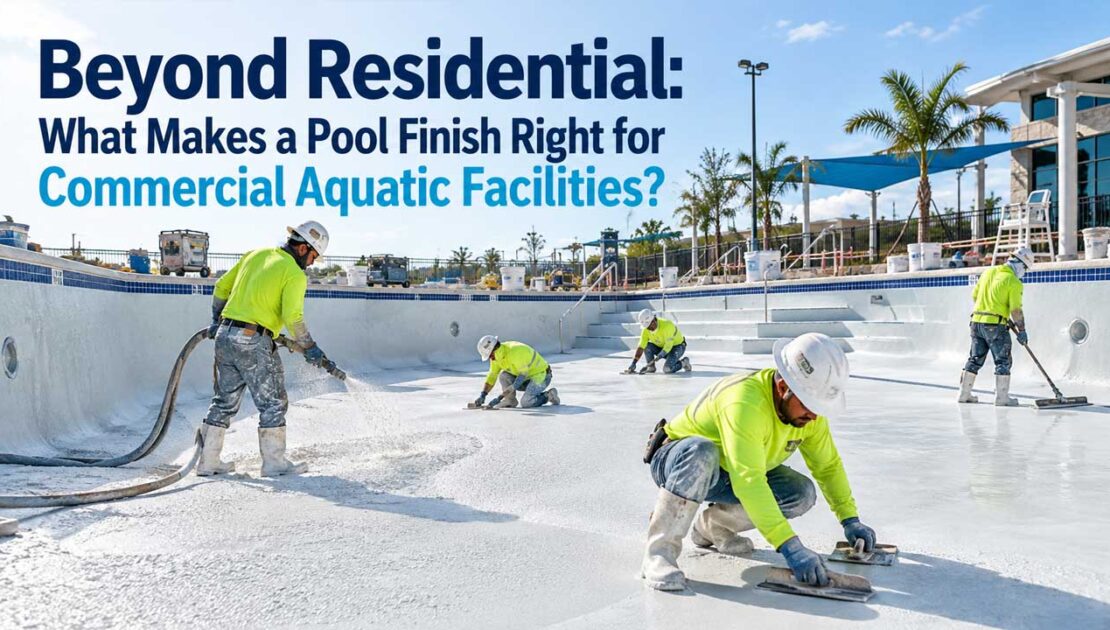
Beyond Residential: What Makes a Pool Finish Right for Commercial Aquatic Facilities?
Universal White Cement examines the material selection, installation considerations, and specification requirements that matter when finishing commercial swimming pools.
A commercial swimming pool has to satisfy a different set of expectations than a residential installation. A hotel pool must remain attractive to guests, a municipal aquatic center needs surfaces that accommodate intensive use and frequent cleaning, and a community pool must serve swimmers of varying ages and abilities.
For professional plasterers, these differences affect how an interior finish should be selected, specified, and installed.
At Universal White Cement, we offer commercial finishing solutions designed around these demands, including jobsite component mixes and factory pre-blended finishes. Understanding the advantages of each approach helps contractors and project specifiers select materials appropriate for the facility, its operating requirements, and the intended finish.
Commercial Pool Finishes Begin With the Right Specification
Before selecting a commercial pool finish, contractors should understand how the facility will be used.
A competitive swimming pool, resort pool, therapeutic pool, and municipal recreation facility may require different surface characteristics. Water depth, swimmer activity, cleaning frequency, accessibility requirements, and the intended appearance can all influence material selection.
For example, a resort may prioritize a particular color palette and visual texture, while a public aquatic center may place greater emphasis on underwater visibility, surface maintenance, and compliance with local health department requirements.
These considerations should be addressed during design rather than after construction begins.
The Centers for Disease Control and Prevention’s Model Aquatic Health Code provides guidance for public aquatic venues, including provisions addressing interior finishes. The code emphasizes that pool colors and finishes must not interfere with the detection of distressed swimmers, algae, sediment, or other objects within the water.
It also addresses the need for durable surfaces suitable for regular brushing, scrubbing, and cleaning.
The Model Aquatic Health Code is guidance rather than a universally adopted law. Commercial projects must comply with the requirements of the applicable authority having jurisdiction (AHJ), which may impose additional restrictions on finish materials, colors, and surface characteristics.
For plastering contractors, confirming these requirements before ordering materials can prevent expensive specification changes later in the project.
Jobsite Component Mixes or Factory Pre-Blended Finishes?
One of the most important commercial material decisions involves how the finish will be prepared.
Universal White Cement offers two approaches through our commercial pool finish solutions: jobsite component mixes and factory pre-blended products.
Jobsite component mixes allow experienced applicators to prepare finishes using separately supplied cement and aggregates.
Our commercial options include a plaster mixture incorporating 98% Ultra White Marble and a mini-pebble mixture using Koolstone White Mini 8/16 aggregate. Both are specified for use with Universal White High-Performance pozzolan-blended cement.
This approach gives contractors flexibility when working with established mixture designs and project-specific requirements.
However, producing consistent results requires careful control of component proportions, material handling, batching, and mixing procedures throughout the installation.
Factory pre-blended finishes offer another approach.
Our Finest Finish Blends combine white Portland cement, our proprietary pozzolanic formulation, and selected aggregates in factory-controlled proportions.
The available materials include pebble, micro-pebble, crushed quartz, and Ultra White Marble Sand, with different textures and color combinations.
Factory blending helps maintain consistent proportions across batches, reducing one source of variation during installation.
For large commercial projects requiring significant quantities of material, that consistency can be valuable. It allows plastering crews to focus on proper placement and finishing while working with a predetermined formulation.
Neither approach is universally preferable. The appropriate selection depends on the contractor’s experience, project specifications, material requirements, and installation logistics.
Selecting a Finish for Appearance and Maintenance
Commercial pool finishes must accommodate both architectural design and routine operation.
White plaster, quartz, and exposed aggregate finishes offer different visual characteristics and surface textures. The appropriate choice depends on the intended application and the facility’s operating conditions.
For hotels and resorts, finish selection may be closely tied to the surrounding architecture and guest experience. Municipal and institutional facilities may have more restrictive specifications governing color, texture, and visibility.
Maintenance practices deserve equal consideration.
Commercial pools frequently require regular brushing and cleaning. Specifiers should verify that the proposed finish is appropriate for those procedures and compatible with the cleaning equipment and chemicals anticipated during operation.
Surface texture also matters, particularly on steps, benches, and other high-contact areas. Contractors should evaluate the completed finish system rather than assume that aggregate size alone determines its suitability.
The objective is to select a material that meets the facility’s appearance requirements while supporting its intended use and maintenance program.

Installation Planning for Commercial Pool Projects
On a commercial project, finish installation is one part of a larger construction schedule. Delays can affect multiple trades, inspections, equipment commissioning, and the planned opening of the facility.
This makes preparation especially important.
Our Finest Finish Blends Installation Guidelines emphasize inspecting the pool structure before application.
Contractors should identify cracks, unstable substrate conditions, moisture intrusion, contamination, irregular surfaces, and other deficiencies that could compromise bonding or appearance.
New concrete and shotcrete shells must meet the specified curing requirements before receiving the interior finish. For Finest Finish Blends, our published guidelines require a minimum 28-day shell cure before finish application.
Renovation projects introduce additional considerations.
Existing coatings, weakened plaster, contaminants, and previous repairs may require removal or corrective preparation before resurfacing. Where appropriate, Universal’s bond coat systems provide an option for preparing existing surfaces to receive a new cementitious finish.
The appropriate preparation method must be determined by the condition of the existing structure and the requirements of the selected finish system.
Why Commercial Documentation Matters
Commercial projects commonly involve architects, general contractors, aquatic consultants, owners, and regulatory officials. Each may require different information before a finish is approved.
Product documentation should therefore be available early in the specification process.
Universal provides installation guidelines, safety data sheets, product information, and warranty documents to support contractors and project teams.
These resources help establish the intended application methods, material characteristics, and manufacturer requirements.
Specifiers should also confirm whether the proposed finish is acceptable to the local health department or other authority having jurisdiction.
A material’s inclusion in a manufacturer’s commercial product lineup does not automatically establish regulatory approval for every public aquatic facility.
For contractors bidding on commercial work, reviewing these requirements before finalizing the estimate helps ensure the selected material is appropriate for the project.
Planning Around Facility Operations
Commercial resurfacing projects often involve additional scheduling pressures because the pool may be an important operating amenity.
A hotel, resort, HOA, or municipal aquatic center may have limited opportunities to close its facility for renovation.
Project planning must therefore account for substrate repairs, surface preparation, finish installation, filling, startup, inspections, and any required water-quality clearances.
The finish itself is only one part of that schedule.
Selecting materials with established installation requirements helps contractors coordinate their work with other project participants. However, no cementitious finish eliminates the need for proper curing, startup procedures, or regulatory approvals.
Owners and contractors should establish realistic reopening expectations based on the entire project scope rather than the plaster application date alone.
Supporting Better Commercial Pool Projects
Commercial swimming pool construction requires more than selecting an attractive interior finish. Materials must be appropriate for the facility, compatible with its operating requirements, and supported by sound installation practices.
At Universal White Cement, our commercial offerings provide professional plasterers with options for both custom jobsite mixtures and factory pre-blended finishes.
Our high-performance blended cement, Ultra White Marble Sand, natural aggregates, and Finest Finish Blends allow contractors to address different project specifications while maintaining control over the materials used.
We also recognize the importance of technical documentation, substrate evaluation, and coordination throughout the installation process.
For commercial plastering contractors, the goal is to select a finish that meets the project’s requirements from the outset—not simply one that looks good at completion.
That approach benefits everyone involved, from the applicator responsible for installation to the facility operator responsible for maintaining the pool.
To explore available materials and technical resources, visit Universal White Cement’s Commercial Pool Finish Options.