
- September 23, 2026
- Universal White Cement
- Pool Finishes
- No Comments
Why Pool Finishes Look Different Underwater: Understanding Light Reflectivity
Universal White Cement examines how independent laboratory testing reveals changes in pool finish color and brightness—and what those findings mean for professional plasterers, builders, and designers.
A swimming pool finish can look remarkably different once it gets wet. A bright white sample may appear darker, a subtle blue may become more pronounced, and colors that seem nearly identical when dry can take on noticeably different characteristics when exposed to water.
For professional pool plasterers and builders, these differences are more than an aesthetic curiosity. They can influence customer expectations, material selection, and how a completed swimming pool is evaluated.
At Universal White Cement, we recognize that color consistency is an important consideration in cementitious pool finishes. Understanding how light interacts with finish materials provides another tool for helping contractors and their customers make informed decisions.
To examine these characteristics, Universal White Cement commissioned independent laboratory testing of several pool finish samples under dry and wet conditions. The results provide measurable evidence of how moisture can influence surface lightness and color.
They also illustrate why selecting a pool interior finish involves more than choosing a color from a dry sample board.
Understanding Light Reflectivity and Pool Finish Color
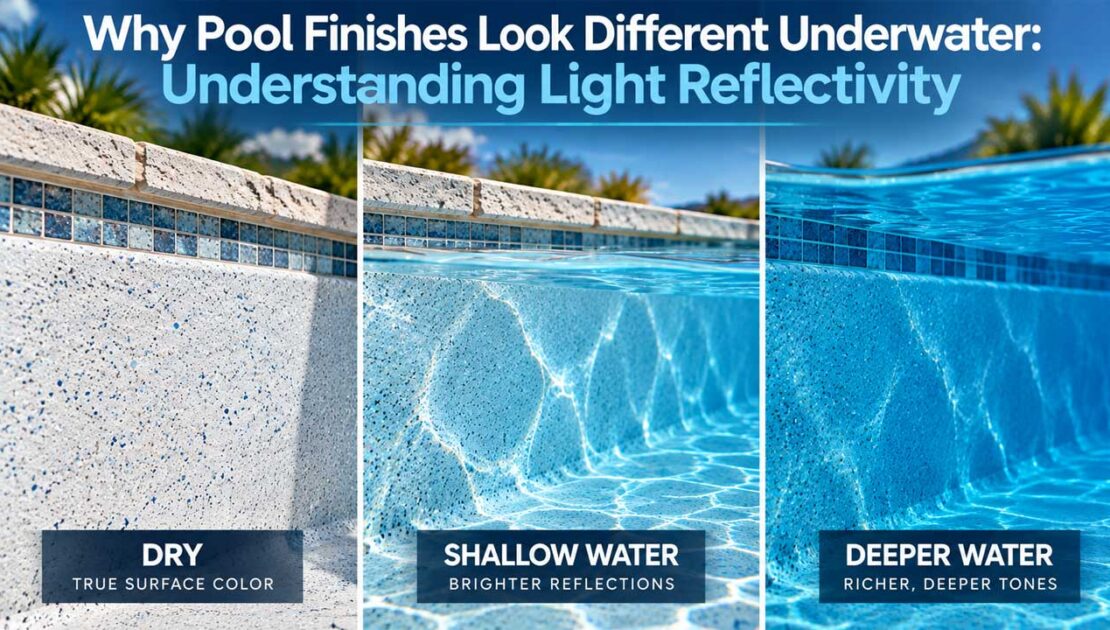
The appearance of a swimming pool interior depends on how light interacts with the finish material, the water, and the surrounding environment. When light reaches a surface, certain wavelengths are absorbed while others are reflected, contributing to the color we perceive.
Surface texture, pigments, aggregate composition, and moisture all influence this interaction. Once a pool is filled, water introduces additional optical effects that can change the apparent color of the interior depending on depth, sunlight, viewing angle, and surrounding reflections.
This explains why a dry plaster sample may look considerably different from the same material after installation. However, understanding those differences requires distinguishing between the measurable color characteristics of a finish and its appearance through several feet of swimming pool water.
How Laboratory Color Measurements Work
In August 2017, DSET Laboratories, a division of Atlas Material Testing Technology, completed an independent evaluation for Universal White Cement under Test Number AE37467.
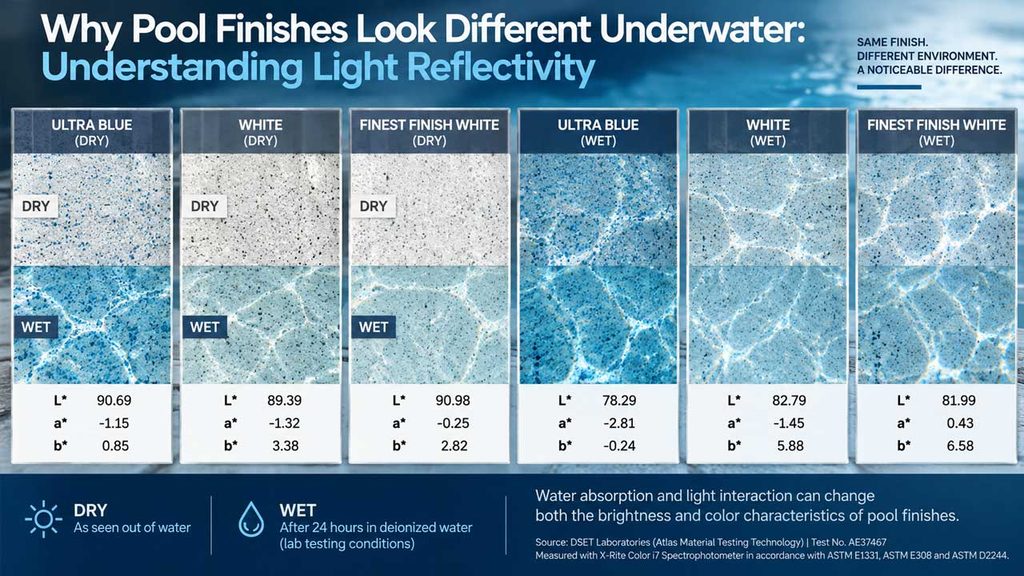
The laboratory examined three swimming pool finish descriptions—Ultra Blue, White, and Finest Finish White—under dry and wet conditions, producing six sets of color measurements. Wet specimens were soaked in deionized water for 24 hours before testing.
Using an X-Rite Color i7 spectrophotometer, technicians measured spectral reflectance across wavelengths from 360 to 750 nanometers. Measurements followed ASTM E1331, with color calculations performed under ASTM E308 and color differences addressed using ASTM D2244.
The results were expressed using the CIE Lab* color system, which describes color through three coordinates:
- L* measures lightness on a scale from 0 (black) to 100 (white).
- a* measures the green-to-red color axis, with negative values indicating green and positive values indicating red.
- b* measures the blue-to-yellow color axis, with negative values indicating blue and positive values indicating yellow.
These standardized measurements allow changes in a material’s appearance to be quantified rather than evaluated exclusively through visual observation.
The complete methodology is documented in the DSET Laboratories Light Reflectivity Test Report.
What Universal White Cement’s Testing Revealed
The laboratory results demonstrated measurable differences in both lightness and color coordinates after the specimens were exposed to water.
All three finishes registered lower lightness values when wet, although the magnitude of the change varied among the materials.
Complete Laboratory Color Measurements
| Pool Finish | Condition | L* | a* | b* |
|---|---|---|---|---|
| Ultra Blue | Dry | 90.69 | -1.15 | 0.85 |
| White | Dry | 89.39 | -1.32 | 3.38 |
| Finest Finish White | Dry | 90.98 | -0.25 | 2.82 |
| Ultra Blue | Wet | 78.29 | -2.81 | -0.24 |
| White | Wet | 82.79 | -1.45 | 5.88 |
| Finest Finish White | Wet | 81.99 | 0.43 | 6.58 |
Source: DSET Laboratories, Test AE37467, August 2, 2017. Measurements used illuminant D65, a 10-degree observer, and included specular reflectance.
Comparing the dry and wet measurements reveals how each material responded to moisture.
| Pool Finish | Change in L* | Change in a* | Change in b* |
|---|---|---|---|
| Ultra Blue | -12.40 | -1.66 | -1.09 |
| White | -6.60 | -0.13 | +2.50 |
| Finest Finish White | -8.99 | +0.68 | +3.76 |
Ultra Blue experienced the largest reduction in measured lightness, declining from 90.69 to 78.29. Finest Finish White followed with a decrease of 8.99 units, while White exhibited the smallest reduction at 6.60 units.
The color coordinates revealed additional differences. Ultra Blue shifted toward the green and blue portions of the color spectrum. White and Finest Finish White both shifted toward yellow, with Finest Finish White also moving slightly toward red.
These findings are particularly interesting because the three finishes began with relatively similar dry lightness measurements. Once wet, their measured characteristics became more distinct.
For professional plasterers, this demonstrates why two materials that appear similarly bright on a dry sample board may not maintain the same relative appearance after exposure to water.
The laboratory findings apply specifically to the specimens tested. They do not represent measurements taken through a filled swimming pool, where water depth and other environmental factors introduce additional optical effects.
Why These Measurements Matter to Pool Plasterers
For contractors, the practical value of reflectivity testing lies in helping customers understand what influences the final appearance of a swimming pool interior.
A homeowner may select a finish based on a small sample, expecting the completed pool to display precisely the same color. Yet the appearance of the installed material depends on several interacting variables.
The finish establishes the underlying color and reflective characteristics. Aggregate exposure, surface texture, water depth, sunlight, and surrounding reflections determine how those characteristics are perceived.
A white interior, for example, can contribute to the familiar blue appearance of a filled swimming pool even though the finish itself contains no blue pigment. This results from the interaction of light with water and the surrounding environment.
Similarly, pigmented finishes can appear lighter on shallow steps and substantially darker in deeper sections of the pool.
These differences are not necessarily evidence of inconsistent materials or improper application. They can result from the optical characteristics of water and the conditions under which the finish is viewed.
At Universal White Cement, we encourage contractors to help customers evaluate finish selections under conditions that resemble the intended installation.
Viewing completed pools, examining wet samples, and discussing the effects of depth and lighting provide a more realistic understanding of the finished appearance than relying exclusively on dry samples.
Why Installation Consistency Still Matters
While laboratory testing helps characterize the appearance of finish materials, consistent results also depend on the materials and practices used during installation.
Cement color, aggregate selection, pigment distribution, mixing water, and finishing techniques can all influence the appearance of a cementitious surface.
Inconsistent batching or excessive mixing water may affect the distribution of materials and the development of the hardened finish. Variations in troweling and aggregate exposure can also create differences in surface texture that influence how light interacts with the interior.
At Universal White Cement, our blended white cement formulations are developed to support professional application and consistent material performance.
Achieving a uniform appearance, however, requires coordination between material selection, mixing, placement, and finishing.
Proper startup procedures are another important consideration.
Freshly installed cementitious finishes must be introduced to properly balanced pool water. Aggressive or scale-forming water conditions can alter the surface over time, potentially affecting both its appearance and durability.
The National Plasterers Council’s recommended startup procedures provide guidance for managing water chemistry, brushing, circulation, and other considerations during the first 28 days.
These practices do not change the laboratory measurements of the original material, but they help preserve the intended appearance of the installed finish.
Using Light Reflectivity Testing to Make Better Finish Selections
The value of laboratory color testing is not that it can predict the exact shade of every completed swimming pool. Rather, it provides objective measurements that help explain why material appearance changes under different conditions.
Universal White Cement’s independent testing demonstrated that all three evaluated finishes exhibited measurable changes in lightness and color after wetting. Importantly, the magnitude and direction of those changes differed among the materials.
For plasterers and builders, this information provides a stronger technical foundation for discussing finish options and establishing realistic customer expectations.
Rather than promising an exact match between a sample and a completed pool, professionals can explain how moisture, depth, lighting, and installation characteristics contribute to the final appearance.
At Universal White Cement, we believe informed material selection is an important part of delivering successful swimming pool interiors. Independent testing helps us better understand how finish materials behave, while consistent workmanship and proper water management remain essential to achieving the desired result.
For additional information, professionals can review the complete DSET Laboratories Light Reflectivity Test Report, including the original color measurements and testing methodology.